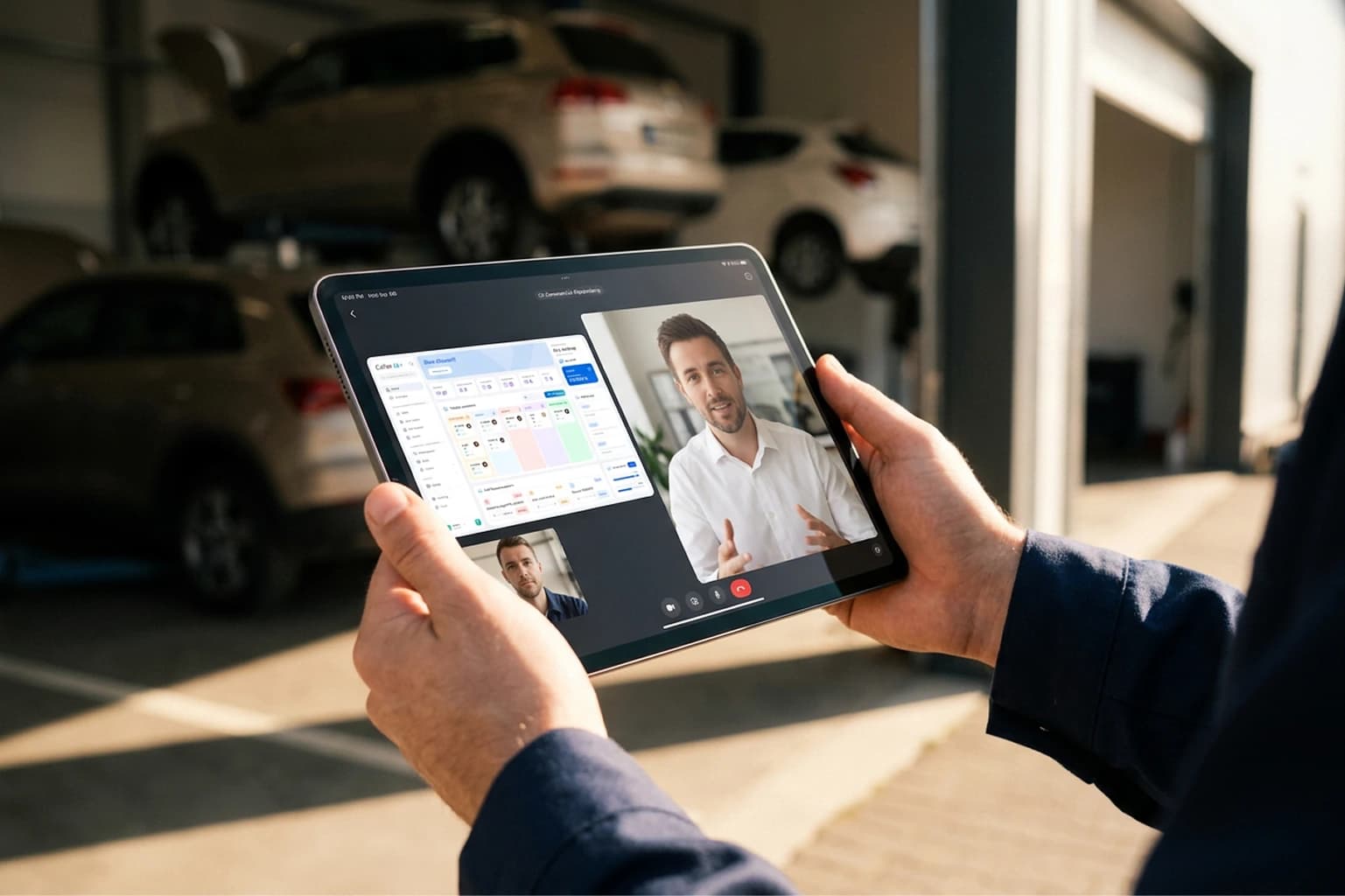
Good workshop management software needs to do nine things: invoice straight from the repair order and sync with your accounting, find the customer and vehicle by plate or VIN, help you manage parts and orders, run digital inspections and repair orders with photos and signatures, handle scheduling, answer your customers when you can’t, work in the cloud and on a tablet, show you clear, published pricing, and let you try it free with a support team that knows the trade.
This guide walks through those criteria as questions, so you can take them to any demo and compare every option the same way.
The best software isn’t the one with the most features in the demo. It’s the one that fits how your workshop already works, from day one.
What is workshop management software?
It’s the system a workshop runs its day on: customers and vehicles, appointments, repair orders, estimates, purchasing and invoicing, all in one place. It replaces the notebook, the spreadsheet and the patchwork of separate tools, so every piece of data is entered once: the plate typed in at check-in is the same one that ends up on the invoice.
The newest systems add a layer of artificial intelligence that does more than store data: it prepares estimates, suggests the order of the day or answers customers, and leaves the final call to the workshop.
1. Does it invoice from the repair order and sync with your accounting?
Ask where the invoice comes from. If it is generated from the repair order, with parts and labor already recorded, nobody types it twice and most billing mistakes never happen. Then ask how it reaches your books: the best setup is one where sales and purchases sync on their own with the accounting tool you already use.
In Cafler, the invoice comes straight out of the repair order and syncs with QuickBooks as soon as you issue it. Supplier invoices go in with a photo: Cafler AI reads them for you. One screen shows what you are owed and what you owe.
2. Can it find the customer and vehicle by plate?
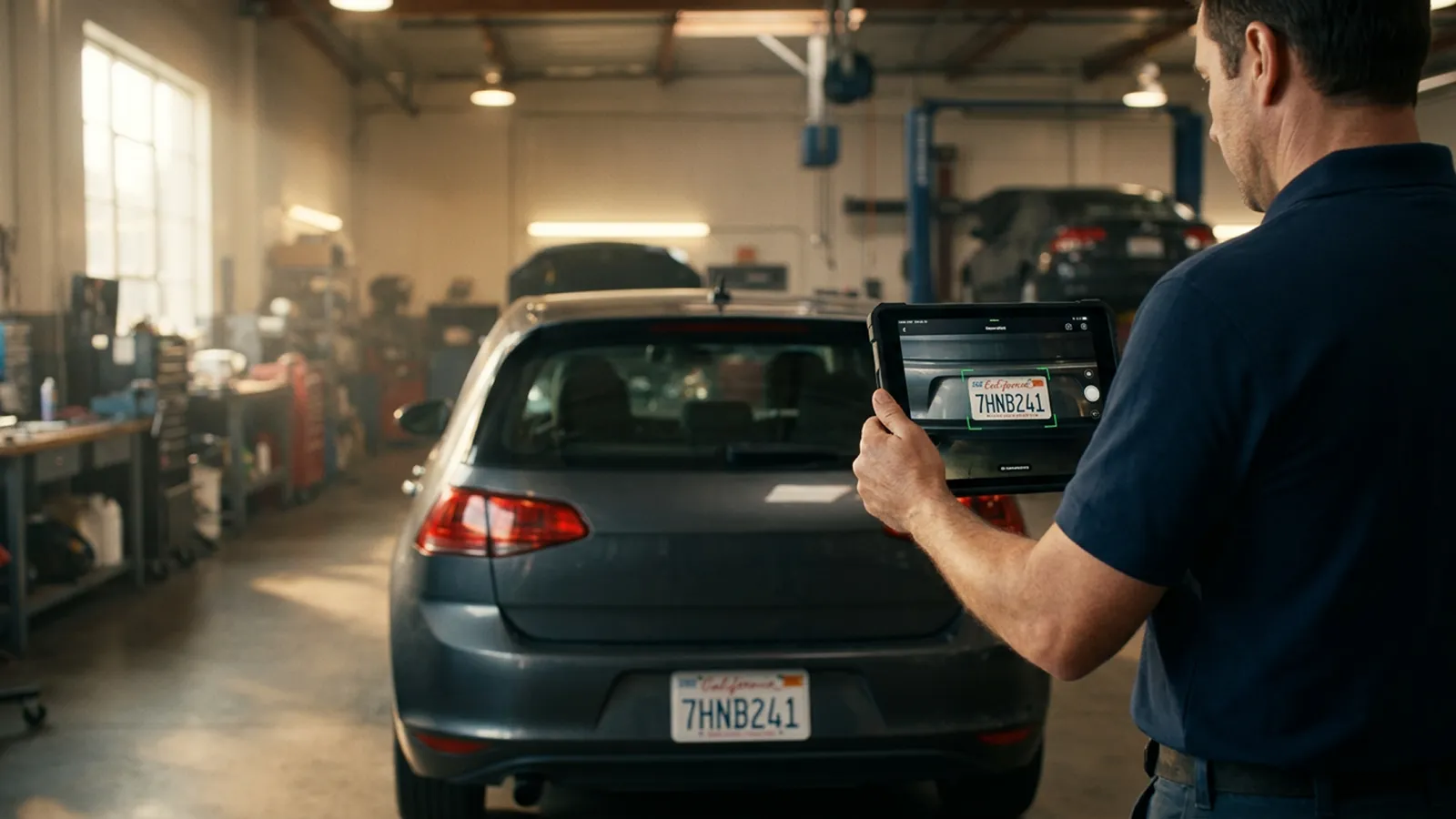
At the front desk, the plate is the key to everything. Good software uses it as a search bar: type the plate and you get the vehicle, its owner and everything that has been done to it, with past visits, mileage and estimates. Cafler OS searches by plate, VIN or customer and keeps the full history of every vehicle.
You don’t even need to type it. Take a photo of the car and attach it in the Cafler AI chat: it reads the plate, checks whether that vehicle is already in your workshop and tells you which customer it belongs to.
3. Does it help you manage parts and orders?
A good chunk of every estimate goes on working out which part you need, whether you have it and who sells it. Check two things: whether the software tracks your own inventory, and whether you can order from the same place instead of opening five supplier websites.
Cafler keeps your inventory and purchase orders inside the platform and links every part to its repair order: if something is missing, the order is flagged until the delivery arrives. And when your suppliers are connected to the marketplace, you place one order and get one invoice, even if the parts come from different suppliers.
Want to know what is landing on the platform before anyone else?
Send me the news4. Are inspections and repair orders digital, with photos and signatures?
The repair order protects both the workshop and the customer: it records the condition the vehicle came in, the mileage, the work that was agreed and the customer’s approval. Filled in on a tablet next to the car, it is complete and signed on the spot.
Check that you can take check-in photos and mark damage on them, capture the customer’s signature on screen and follow the order step by step until handover. Cafler OS has a quick repair order you can fill in within a minute, and a full one with check-in, inspection checklist, assigned technicians, parts and a handover signature.
5. Does it handle scheduling and workshop status?
A workshop schedule is not a calendar: every appointment needs a time, a technician and a bay. Ask whether the software accounts for opening hours, the real duration of your services and your bays, and whether it shows you what is being worked on right now, not just what was planned.
In Cafler, when you book an appointment the platform suggests a technician and a bay based on the day’s workload, and Cafler AI flags the bottlenecks as soon as you open the schedule. It suggests and shows where the data comes from; you decide.
6. Does it answer your customers when you can’t?
The phone always rings when your hands are in an engine. That’s why more and more workshops look for AI-powered customer service: an agent that answers on WhatsApp at any hour, books appointments into real openings and prepares the estimate with your prices.
The key question is how much it knows about cars. A generic chatbot can hold a conversation; one built for workshops understands the markings on a tire or the symptom a customer describes, and when something goes beyond what it knows, it hands the conversation to someone at the workshop with the full history in front of them. Cafler’s agent works that way, connected to your schedule and your catalog, and everything it does is logged in the platform.
7. Is it cloud-based and does it work on a tablet?
Cloud software runs on the front-desk computer, the check-in tablet or your phone, with nothing to install and no server in the workshop, automatic backups and always the latest version. If you run more than one location, it’s also how you see all of them at once.
Ask about your data too: where it is stored, whether it is encrypted and whether you can export it whenever you want. In Cafler your data is encrypted, backed up daily and always belongs to the workshop.
8. Is the pricing clear and published?
You should be able to see what it costs before you sit through a sales call. Look for plans and prices on the website, with what each one includes, and a way to grow without changing systems when you add a location.
Cafler publishes its plans on the website: a Free plan to get started at no cost, Starter for a single workshop, and Growth and Pro for groups, priced per location.
9. Can you try it free, and who supports you?
No product page beats seeing the software with your own cars in it. Look for a free trial with no commitment and ask who will help you get set up: a contact form is not the same as a team that knows the trade.
Cafler offers a 30-day free trial in your real workshop, with full onboarding and no long-term commitment. Founded in Barcelona in 2021, inside automotive aftersales, Cafler today works with more than 1,200 workshops across Europe, the Americas and Asia.
“The best demo is the one you run with your own workshop: your services, your customers and a real day.”
How to get the most out of the trial
Any software needs to know your workshop before it can show you what it can do. Spend the first hour of the trial on these four things and the rest will follow:
- Your business details and invoice numbering, so you can issue a real invoice.
- Your services with their real duration, the time your team actually takes, because that is what the schedule is built on.
- Your technicians and bays, with what each one does.
- A handful of customers and vehicles, or an import of the ones you already have.
Once that’s done, run the full journey with a real car: appointment, check-in with photos, estimate, part, invoice. In one afternoon you’ll know whether the software fits your workshop.
Checklist: what your workshop software should have
- Invoices generated from the repair order, synced with your accounting.
- Plate and VIN lookup, from a photo too, with the full history of every vehicle.
- Parts inventory and purchase orders in the same system.
- Digital inspections and repair orders with photos, marked damage and customer signature.
- Scheduling with technicians and bays, plus a live view of the work in progress.
- AI customer service on WhatsApp, with handover to a person at the workshop.
- Cloud-based, usable on tablet and phone, with encrypted, exportable data.
- Clear, published pricing.
- A free trial and a support team that knows the trade.