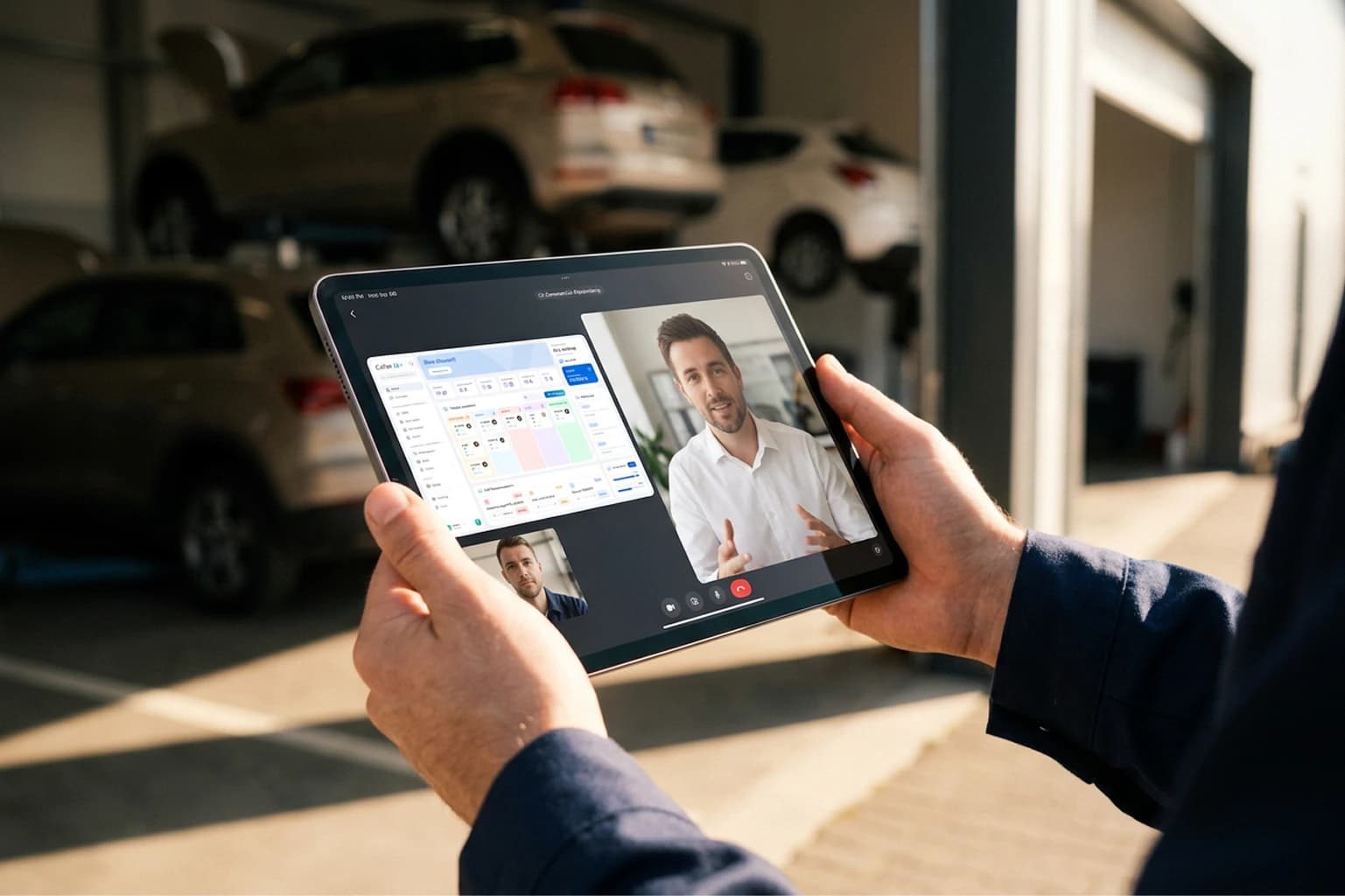
Three vehicles on the lifts, one waiting for diagnosis and a customer at the counter who needs a quote explained. The phone rings. It rings four times.
Nobody can pick it up, because everyone is doing exactly what that customer is calling about: good work.
The caller wanted a booking for a service. Thirty seconds later they’re dialling the next workshop on the Google list.
That scene isn’t a failure of the team. It’s the consequence of something structural: a workshop runs two jobs at once — repairing vehicles and looking after the people who bring them in — and both compete for the same hands and the same hours.
Peak call time is peak workshop time
This is the crux of it, and it’s why the answer isn’t asking the team to try harder: the moments when a customer looks for an answer are exactly the moments when the workshop is at full capacity.
- First thing in the morning, vehicle drop-offs and calls from people organising their day arrive together.
- Mid-morning, with every bay occupied, the follow-up questions come in: “is it ready?”, “how much will it be?”.
- At closing time, messages pile up from people who have just finished work and only then had a chance to write.
- And after hours, with the workshop closed, people are deciding who they’ll take their vehicle to tomorrow.
Each of those conversations is short — two, three, four minutes — and that’s precisely why nobody counts them. Added up, they’re what decides how many bookings land in next week’s diary.
The sum almost no workshop has done
You don’t need to take any market figure on trust: the sum that matters is your own, and it comes from three numbers you already have.
- How many calls go unanswered on a normal day (check the phone log for any given week).
- Your average repair order value.
- How many times a year a customer who stays with you comes back.
Multiply the first by the second and you’ll see the size of the week. Multiply by the third and you’ll see the real size, because an unanswered call is rarely a single repair: it’s the entire relationship with that customer, plus the referrals that came with them.
“Customers no longer compare your workshop with the one down the road. They compare it with the last conversation they had by message with any other business — and there, the reply came in a minute.”
Want to know what is landing on the platform before anyone else?
Send me the newsWhat keeps a customer today (and it isn’t price)
The most revealing figure in the sector says nothing about rates. Cox Automotive’s 2025 aftersales study, based on almost 2,000 drivers who had used a workshop in the previous twelve months, found that 45% were dissatisfied with the experience, and that the two main reasons were unexpected costs and poor communication. Not the quality of the repair: the communication.
The same study shows the other side of the coin: nearly 8 in 10 drivers value getting text updates about their service. And messaging apps are now where customers expect that conversation to happen.
Speed isn’t a cosmetic detail either. The classic reference study on response times (MIT / InsideSales) measured that making contact within the first 5 minutes makes you 21 times more likely to convert that enquiry, compared with waiting half an hour. In a workshop, half an hour is how long it takes to finish the job in front of you.
How the workshops that have solved it organise themselves
The good news is that this can be designed, just like the diary or the reception flow. The workshops that handle it best share five simple decisions:
- A single inbound channel for every conversation, instead of splitting them across the phone, personal mobiles and email.
- Ready-made answers for what gets asked every time: opening hours, indicative prices, how to drop off the keys, how long it usually takes.
- A proactive update at every change of stage, so the customer never has to call and ask.
- A way to capture what comes in after hours and turn it into a booking the next morning.
- The conversation history attached to the vehicle, so anyone on the team can pick it up without starting over.
Every conversation answered in time is a booking confirmed, a quote moving forward and a customer who comes back. Answering is workshop work.
When the answer no longer depends on who’s free
The step that gives the team the most time back is this one: that the conversation keeps moving in those minutes when nobody can pick it up. That whoever asks about opening hours gets them. That whoever wants a booking makes it. That whoever asks about their vehicle knows where it stands. And that the team steps in when human judgement is genuinely needed, which is where their experience counts.
That’s where answering stops competing with the workshop and starts adding to it: the counter is free for the person standing in front of you, and whoever calls at 11:20 on a Tuesday gets an answer too.