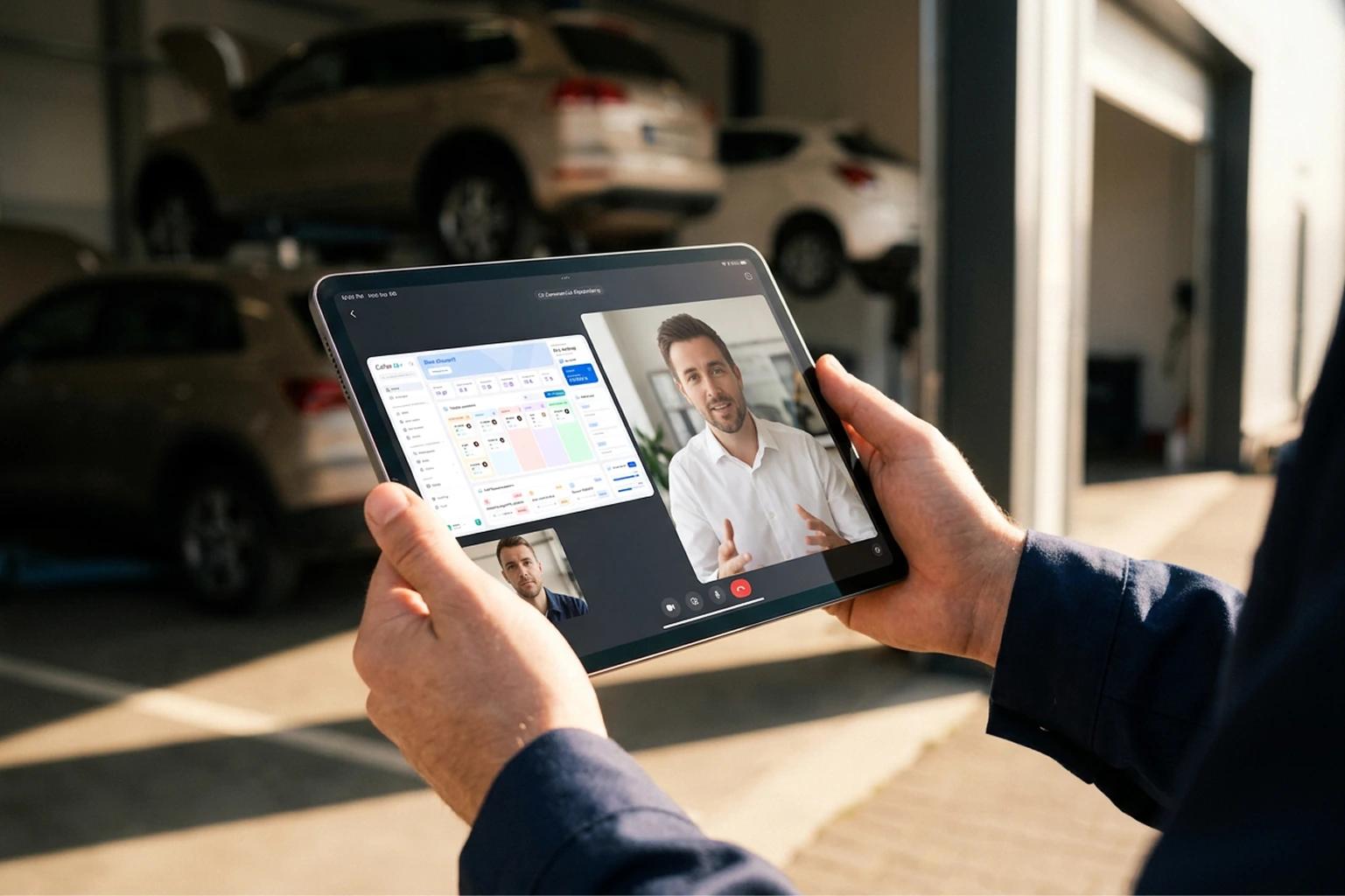
The Mégane customer walks in with a question: “It’s making a noise when I brake. Didn’t you change the pads not long ago?”
The person who would know off the top of their head is on holiday. The front desk starts searching: the March invoice is in one folder, the work order in another, and the photo of the discs is on the phone of the technician who did the job.
In the end it all turns up. Yes, the pads were changed in March. And on that same estimate there was a line the customer had left for later: the discs.
It was the right answer. It just took twenty minutes to get there.
Nobody did anything wrong. The workshop had every piece of information: when the vehicle came in, what was done, what was recommended and what the customer decided. What it didn’t have was one place where it all sat together, without depending on who happened to be at the front desk that Monday.
That is what this article is about: the vehicle history is the workshop’s memory. If every visit leaves its trace in the same record, the answers are there when the customer comes back, and whatever was left pending becomes the next visit instead of a nasty surprise.
A workshop doesn’t remember its customers because it has a good memory. It remembers them because every visit is written down in the same place.
What is a vehicle history?
It is everything the workshop knows about a vehicle, in date order and in a single record: every time it came in, what was done, what was estimated, what was invoiced and what was left for later. It isn’t the manufacturer’s service book or the report from one visit: it is what has happened in your workshop, visit by visit.
If a well-kept work order is the journey of one visit, as we described in the work order article, the history is what remains of all of them together. And it is what turns a returning customer into a customer you already know.
What each vehicle’s record holds
In Cafler, every vehicle has its own record in the CRM, always linked to its customer, and everything that happens in the workshop lands there without being copied over by hand:
- The vehicle details: number plate, VIN, make, model, year, fuel type and the mileage at every visit.
- The history, in date order: every visit with the work that was done.
- The estimates, including the ones the customer declined or left for later.
- The work orders and invoices, each one linked to the visit it came from.
- The photos, attached to the work order they were taken for, with their date.
- Documents and internal notes: what the customer signed and what the workshop wants to remember (“prefers a call in the afternoon”).
The important thing is that none of this is written for the history. It is written once, while doing the work, and the history picks it up.
When the customer comes back: answers in ten seconds
Most of the questions customers ask at the front desk are answered by their vehicle’s past: what was replaced, when, how much it cost, what was recommended. With the history at hand, you answer them without searching:
- Find it from any detail. A single search covers the name, phone number, email and the number plate of any of the customer’s vehicles.
- See the whole visit: the work order, the before and after photos and the invoice, on the same screen.
- See what was left pending: the estimate line the customer put off until another time, with its date.

This matters more than it seems. In the United States, Cox Automotive’s 2025 service industry study found that almost half of owners (45%) are not satisfied with their dealership’s service, mainly because of unexpected costs and poor communication. Both are fixed the same way: knowing, right then, what was done and what is still to do.
“A customer who gets an answer in ten seconds doesn’t feel they are coming back to a workshop: they feel they are coming back to their workshop.”
Want to know what is landing on the platform before anyone else?
Send me the newsWhat hasn’t been done yet is history too
The lines the customer leaves for later are probably the most valuable part of the history. They are jobs the workshop has already diagnosed, that the customer already knows about and that will need doing sooner or later.
If they get lost in a folder, they come back like in the opening scene: as a noise when braking and an awkward question. If they stay in the record, they come back as what they really are: the next visit, already prepared, with the estimate done and the customer told in good time.
From the history to the next follow-up
A complete history isn’t only for answering questions: it lets you get ahead of them. It is what the CRM agent of Cafler AI, the AI for aftersales, uses to prepare the workshop’s follow-ups every day:
- Who is worth calling or messaging today, and why: the inspection that’s due, the service that’s coming up, the estimate still waiting for a reply.
- The WhatsApp message, ready to go, with the name, number plate and dates already filled in from the record. It goes out when you tap send: nothing goes out without your OK.
- Only to those who have consented. The list only includes customers who signed the notification consent.

And everything sent to the customer goes back into the record, under their communications. The next time they come in, that will be history too.
So the workshop’s memory doesn’t depend on one person
Every workshop has someone who remembers everything. It is lucky to have them, and risky to depend on them: they go on holiday, change shifts or, one day, change jobs.
With the history in the record, anyone on the team can look after a long-standing customer just as well. And the record also keeps who made each change and when: if someone corrects a phone number or an email, it is logged. The workshop’s memory now belongs to the workshop.
What to set up for it to work
The history fills itself, but it needs the workshop to work in a particular way. There are four things, and almost all of them already happen when the vehicle is checked in:
- Register every vehicle with its number plate and mileage, linked to its customer. It is the only required step, and it is what lets you find it later.
- Run the work through the estimate and the work order, not a notebook. Whatever doesn’t go into the work order doesn’t reach the history.
- A signed notification consent, so the customer can receive their reminders on WhatsApp.
- Bring in the customers you already have. You can hand them to Cafler AI in an Excel file, a PDF or a photo of your paper records, and it registers them for you.
On day one the history is almost empty. A few months later it is the most consulted tool at the front desk.
A few weeks later
Another Monday, another question. The Mégane customer calls: “When was I due for the discs?” The front desk types in the number plate. There is the March visit, the photo of the discs and the line left pending.
But there is no need to answer: on Friday the workshop already sent a WhatsApp reminder, with a slot free on Wednesday. They were calling to confirm the appointment.