
The Golf’s owner walks in to collect it. At the front desk, the invoice does not exist yet.
To put it together, four pieces of paper have to come together: the check-in sheet with the mileage, the estimate the customer approved over the phone on Tuesday, the hours the technician jotted down in a notebook, and the hose that turned up halfway through the repair and was added by word of mouth.
Ten minutes later there is a total. The customer looks at it and asks the only question that matters at that hour: “Is this what we agreed?”
The answer is almost always yes. But to give it with confidence, someone has to rebuild the vehicle’s whole journey through the workshop, and that is exactly what should not be necessary. Every one of those details was already written down once: at check-in, when the estimate was approved, when each job was finished. The invoice should simply collect them.
That is the idea behind this article: a well-kept work order already is the invoice, just not issued yet. What follows is a vehicle’s journey through the workshop, from arrival to handover, and what gets recorded at each point so that nothing has to be written at the end.
The invoice is not made at the end. It is written along the work order, and at the end it is simply issued.
What is a work order, and why does it lead to the invoice?
The work order is the document that follows the vehicle from the moment it arrives until it leaves: who brings it in, what condition it is in, what will be done, who does it, how long it takes and which parts are used. It is also the document the customer and the workshop sign when the vehicle is dropped off.
If every step is recorded in it, by the time you reach the front desk the invoice already has everything it needs: the customer and the vehicle, the approved jobs, the parts and the labour. If it is recorded in different places — a sheet, an email, a notebook — the invoice becomes a collection job, and the journey ends with ten minutes of searching in front of the customer.

Check-in: what is written once and never repeated
Everything starts at the door. It is the moment when the most new information comes in at once, and the one that decides how much will have to be repeated later:
- The customer and the vehicle, found by plate number, name or phone. If they have been in before, their details are already on file and nobody types them again.
- The condition on arrival: bodywork damage marked by zone, the mileage and the fuel level.
- What the customer asks for, in their own words: the noise when braking, the service, the warning light.
- Both signatures, the customer’s and the workshop’s, on the check-in document.
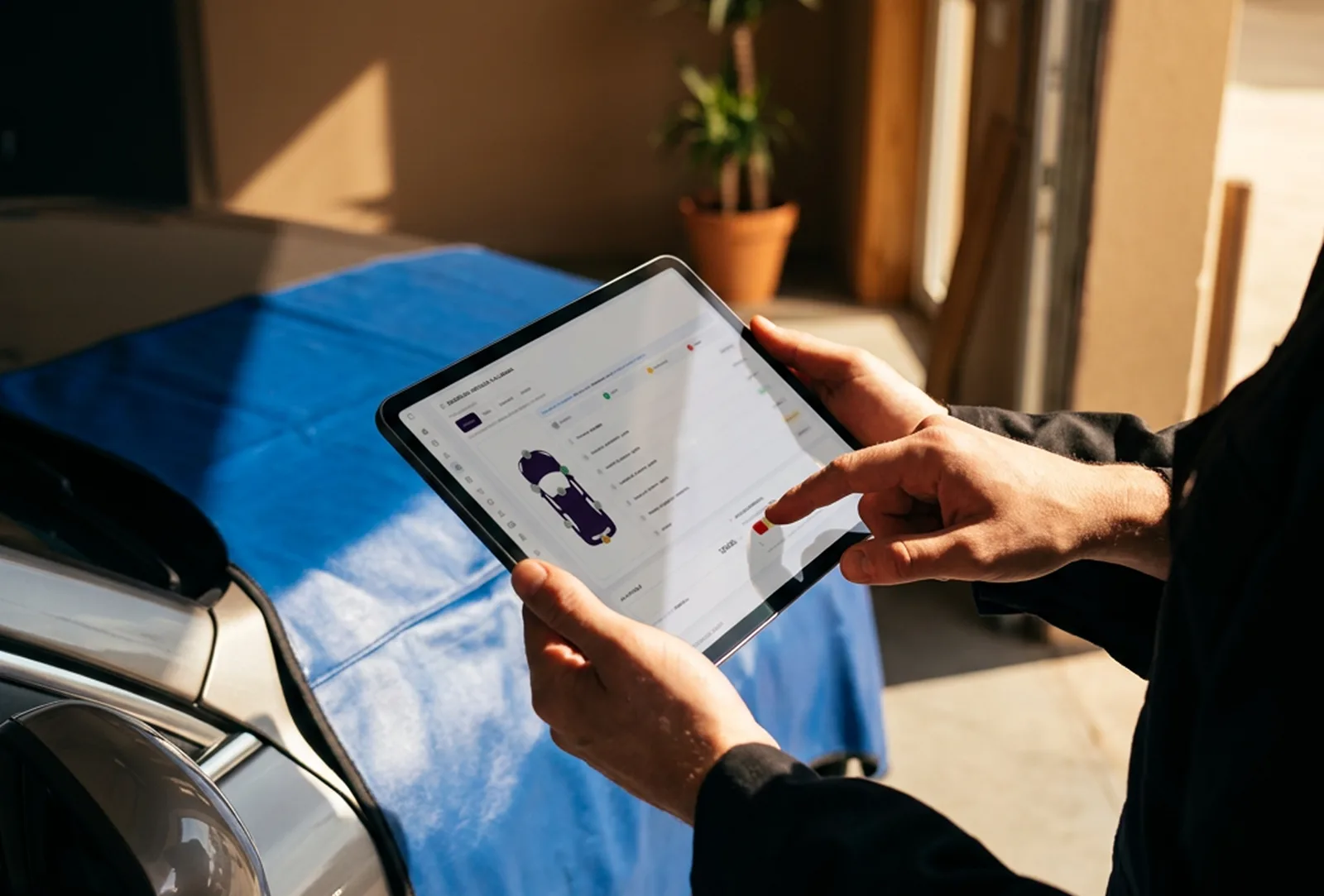
In Cafler, the quick work order captures all of this in the time check-in takes. And the estimate comes straight out of it, without retyping the customer, the vehicle or the jobs.
The estimate: what the customer approves is what gets invoiced
The most delicate stretch of the journey is the middle one: when the technician inspects the vehicle and finds something that was not expected. That is where it is decided whether the final invoice will match what the customer expects.
In the United States, Cox Automotive’s 2025 Service Industry Study offers two clear signals. Among customers who had a frustration at their last dealership service visit, 12% say the final price was higher than the estimate, and 13% that it was hard to find out how much they would be charged. In the same study, 72% consider it important to be able to review and approve the estimate online or in an app, although only 24% have ever done so.
The takeaway works in any country: customers are not asking to pay less, they are asking to know beforehand what they will pay and decide for themselves. If the estimate they approve is the same document the invoice comes from, the front-desk question is answered before it is asked.
This is where Cafler AI, the AI for aftersales, lends a hand. When the inspection is finished, it sorts what the technician found by priority — safety first, then what is recommended — and prepares a WhatsApp message asking the customer whether they would like an estimate. Nothing goes out without your OK. If the customer says yes, the estimate is left in draft with those lines; you review it, send it, and they accept or decline it from the link itself.
“Customers are not asking to pay less: they are asking to know beforehand what they will pay and decide for themselves.”
The workshop floor: every phase with an owner and its real time
Once the estimate is accepted, the vehicle moves onto the workshop floor. Here the work order stops being a sheet and becomes a board: every job is a phase, with its technician, its bay and its status.
- The real time of each phase. The technician starts, pauses and completes the task, and the time is recorded without writing it in any notebook.
- Photo and video evidence, attached to the phase in which it was taken, with date and time.
- Parts, linked to the order. If one is missing, the order is blocked and an alert is raised until the delivery arrives; once received, the part is assigned and the job carries on.
- Jobs that come up along the way, added to the same order instead of being agreed by word of mouth.
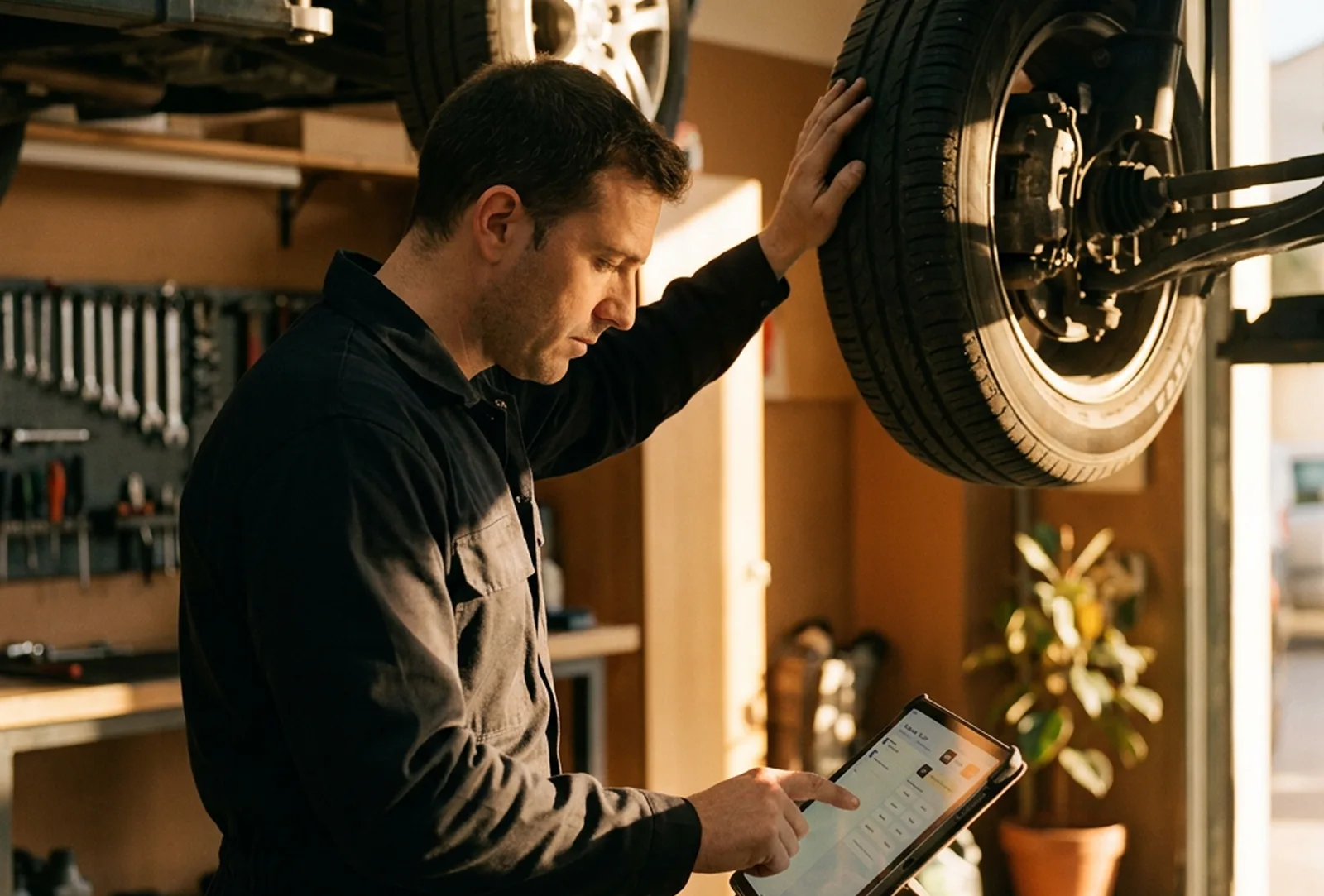
The hose in the opening scene is exactly that: one more job that, if it goes into the order as soon as it appears, reaches the invoice without anyone having to remember it.
The invoice: it comes out of the order, it is not written again
When the last job is completed, the invoice is not started: it is reviewed. The jobs, the parts and the labour are already in the order, so three steps remain at the front desk:
- The pro forma, if the customer wants to see it first, with exactly what they approved.
- The payment, there and then — card, cash or bank transfer — or on terms, at 15, 30 or 60 days.
- The invoice, issued from the same screen as soon as a payment method is set. If you work with a connected ERP or accounting software, your ERP issues it and nobody has to copy it across.
What matters here is the order of things: the invoice is the last step of the work order, not a separate document. That is why it matches what the customer approved: it comes from the same lines.
Handover: the vehicle leaves as it arrived, with its invoice
One step is left, and it closes the loop with check-in. The mileage and fuel recorded on arrival are already filled in to be checked, the exit photos are taken and the customer signs for the handover. Handover does not open until the invoice has been issued, so every vehicle leaves the workshop with its invoice done.
And everything stays in the order: who did what, when, with which photo and which document. If the customer asks in six months what was replaced, the answer is in one place.
What to set up so the journey runs smoothly
Like any journey, this one only flows if the road is ready. There are five things; you set them up once and from then on they work on their own:
- The service catalogue, with prices and real durations. This is what lets jobs reach the estimate with an amount already on them.
- Technicians and bays, so every phase has an owner and a place.
- Tax details and invoice series, so the invoice carries its number from day one.
- Stock, or at least the parts you use most, to link them to the order without searching.
- The connection to your ERP or accounting software, if you use one.
With that in place, every work order leads to the invoice on its own. It is the least glamorous part, and the one that gives back the most time.
A few weeks later
Same front desk, same time, a different vehicle. The invoice is already on screen when the customer walks in: check-in with its mileage, the estimate they accepted from their phone, the part that was added to the order as soon as it came up and the time of each phase. Payment is taken, the invoice issued and the handover signed in the time it takes to hand back the keys.
When the customer asks “is this what we agreed?”, the answer is the same as always. Only now it is written down.