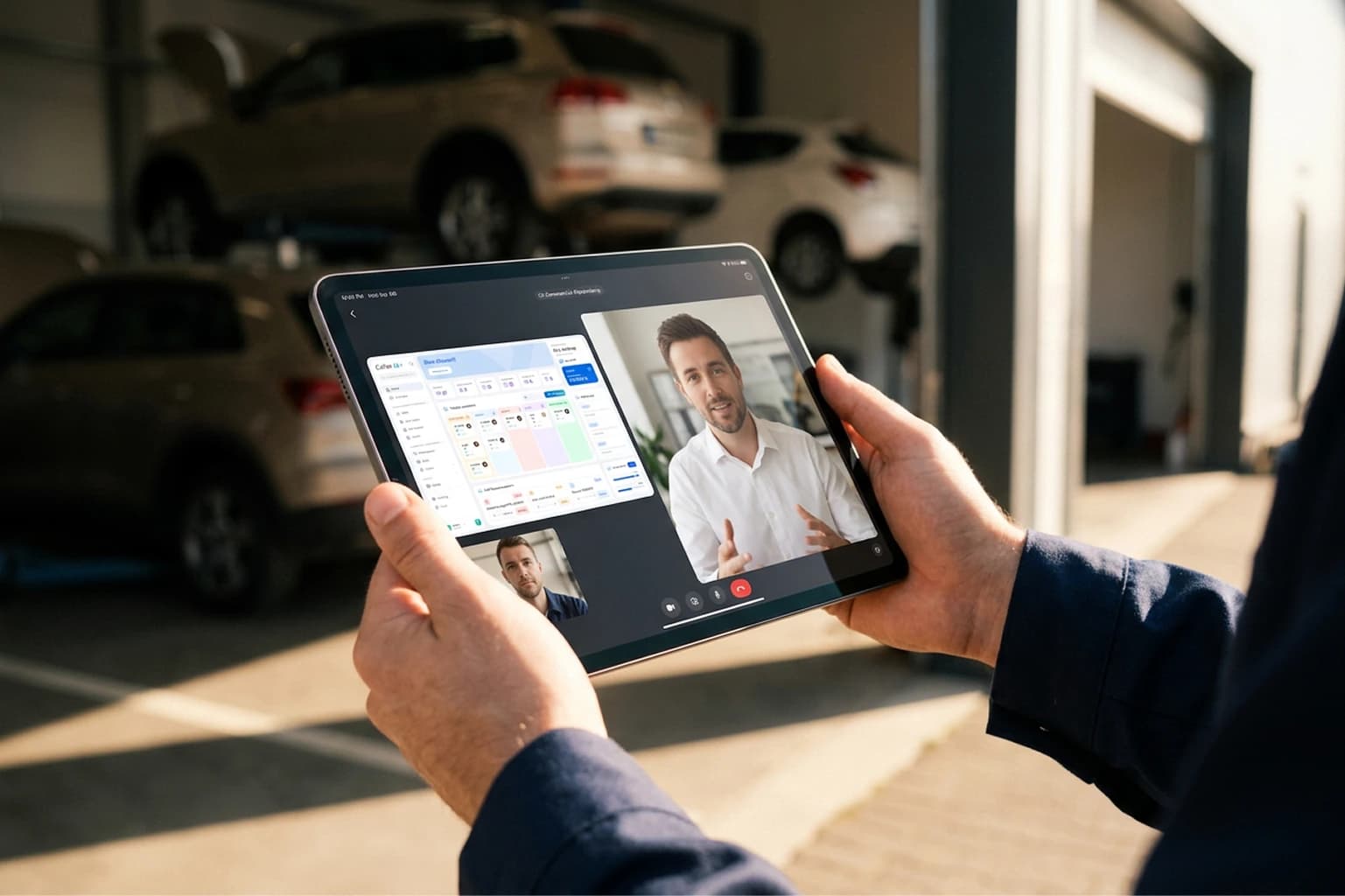
Every industry reaches a moment when everything starts to change, and this is aftersales’ moment. For years, the sector has tried to solve its complexity by adding programs: one tool for bookings, another for diagnostics, another for quotes, another to notify the customer. The result isn’t more control, but more disconnected layers that someone has to coordinate by hand every day.
The change that’s coming isn’t another tool. It’s a change at the foundation: moving from disconnected ecosystems to connected intelligence. It’s what we call being AI-native.
What “AI-native” means
An AI-native system isn’t a program with a chatbot bolted on. It isn’t one more layer on top of what you already have. It’s the foundation the entire business runs on: intelligence at the centre, not stuck to the edge.
The difference is clearest by contrast:
- From manual processes → to AI-powered experiences.
- From traditional software → to intelligent systems that evolve with the sector.
- From disconnected ecosystems → to a single connected layer of intelligence.
Want to know what is landing on the platform before anyone else?
Send me the newsThe problem was never a lack of talent
Aftersales is an industry driven by people: professionals with deep knowledge, teams that know exactly what they’re doing. And yet, operating becomes far more complex than it should. Not for lack of knowledge or talent, but because of everything around it: processes that demand too much coordination, systems that aren’t always connected, and an operation that depends on constant effort just to move forward.
“This industry doesn’t need more tools. It needs a better way to operate.”
From data to action
An AI-native operating system doesn’t just store information: it interprets it and acts on it in real time. In practice, that means the system itself:
- Turns every incoming request into a confirmed booking, automatically.
- Generates accurate diagnostics and quotes before the customer walks through the door.
- Coordinates workstations, tasks and priorities in real time, with no manual intervention.
- Keeps the customer informed at every stage, without anyone having to chase updates.
- Monitors financial performance and flags what needs attention before it becomes urgent.
From data to action. From systems to intelligence. From operating well to operating at full potential.
From connecting aftersales to building its intelligence
Cafler started by building the infrastructure to move vehicles and connect services across aftersales: today, more than 1,200 workshops in 9 countries and over 500,000 vehicles managed. Listening to those customers, we understood that the real challenge wasn’t moving cars, but the operational complexity of day-to-day work. That’s why the next step wasn’t another tool: it was building the intelligence that makes everything else work.
That’s the leap we’re taking: moving from connecting aftersales to building the intelligence that powers it. In the coming articles, our CEO explains first-hand why we decided to take this step.